
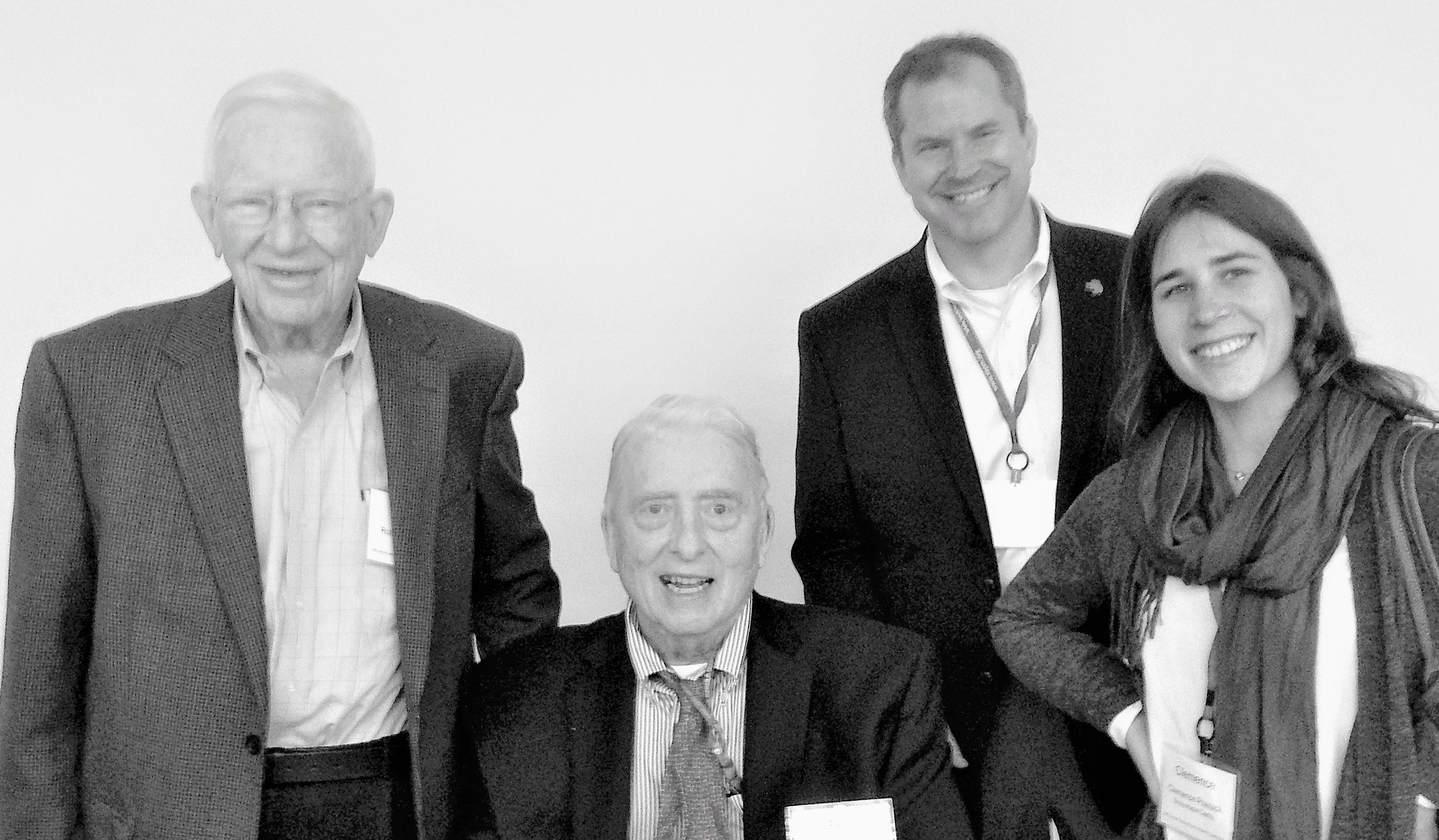
Three generations of seismic and sequence stratigraphic interpreters.
From left to right – Robert Mitchum, Peter Vail, Jack Neal, and Clémence Prazuck.
Overview:
The 36th Annual GCSSEPM Foundation Perkins-Rosen Research Conference was held on December 4-5, 2017, at the Marathon Conference Center in Houston. The theme was “Sequence Stratigraphy: The Future Defined” and the conference coincided with the 40th anniversary of the landmark 1977 publication, edited by Charles E. Payton, i.e., “AAPG Memoir 26 – Seismic Stratigraphy: Applications to Hydrocarbon Exploration”.
GCSSEPM conferences have always provided the focus for timely discussions and the December 2017 conference was no exception. Exxon’s view on the state-of-the-discipline and their observational methods was presented by Jack Neal, with reminders on the importance of unconformities presented by Gregor Eberli. The value and application of large 3D seismic data sets to interpretations at varying scales, were highlighted by presentations by Ole Martinsen, and by Henry Posamentier. At the regional scale, John Wagner presented work on the Late Paleocene to Early Eocene deep-water deposits of the Gulf of Mexico and, at the global scale, Frans van Buchem presented work aimed at predicting global hydrocarbon sweet spots.
Modeling, as a means to test hypotheses and to challenge accepted views, was addressed during presentations by Peter Burgess, as well as by Zoltan Sylvester and Ashley Harris. Other areas of additional insight were in the fields of carbonate sequence stratigraphy, where separate papers presented by Charlie Kerans, Remi Joussiaume, Xavier Janson, Martin Honig, Pankaj Khanna, and Diana Ortega-Ariza, examined the complex factors that drive the carbonate factory, from ocean chemistry and circulation patterns to changes in sea-level and salt tectonics. Marcello Minzoni gave an overview of the lacustrine carbonates of the Brazilian margin, and R. Arnott on the mixed carbonate-siliciclastic deep-marine deposits of Neoproterozoic Laurentia. Together, these presentations highlighted carbonates that ranged in age from Precambrian to Miocene.
The current interest in unconventional resources has resulted in increased attention to shales, and the conference saw presentations by Bryan Turner on chemostratigraphy, Sébastien Castelltort on the use of carbon isotopes in slope successions, Frederick Sarg on depositional cycles and sequences, as well as by Richard Denne on challenges in the application of biostratigraphy, Bruce Hart on shale sequences, and Stephen Sonnenberg on the Bakken and Three Forks Formations.
The Quaternary remains a valuable time period for stratigraphic studies, as evidenced by papers on the Po Plain system presented by Alessandro Amorosi, on the Po River lowstand wedge presented by Claudio Pellegrini, and on the Indus River System by Peter Cliff. The figure on the left is an example of a high-resolution sparker profile across the Po River wedge from Pellegrini et al., which was also featured as the program cover for the conference.