
In May, we attended the AAPG Annual Convention in Salt Lake City, Utah as well as pre-convention field trips.
– – – – – – – – – – – – – – – – – – – – – – – – – –
Field Trip 04 – Stratigraphic Elements of Shoreface and Deltaic Strata, Upper Cretaceous of the Northern Book Cliffs
Clémence attended the SEPM pre-convention filed trip FT04 – Stratigraphic Elements of Shoreface and Deltaic Strata, Upper Cretaceous of the Northern Book Cliffs. Instructors for the trip were Diane Kamola, Jesse Thompson and Kirt Campion. Kirt Campion co-authored AAPG Methods in Exploration Series, N.7, entitled Siliciclastic Sequence Stratigraphy in Well Logs, Cores, and Outcrops, which placed many of these outcrops in to a sequence stratigraphic framework.
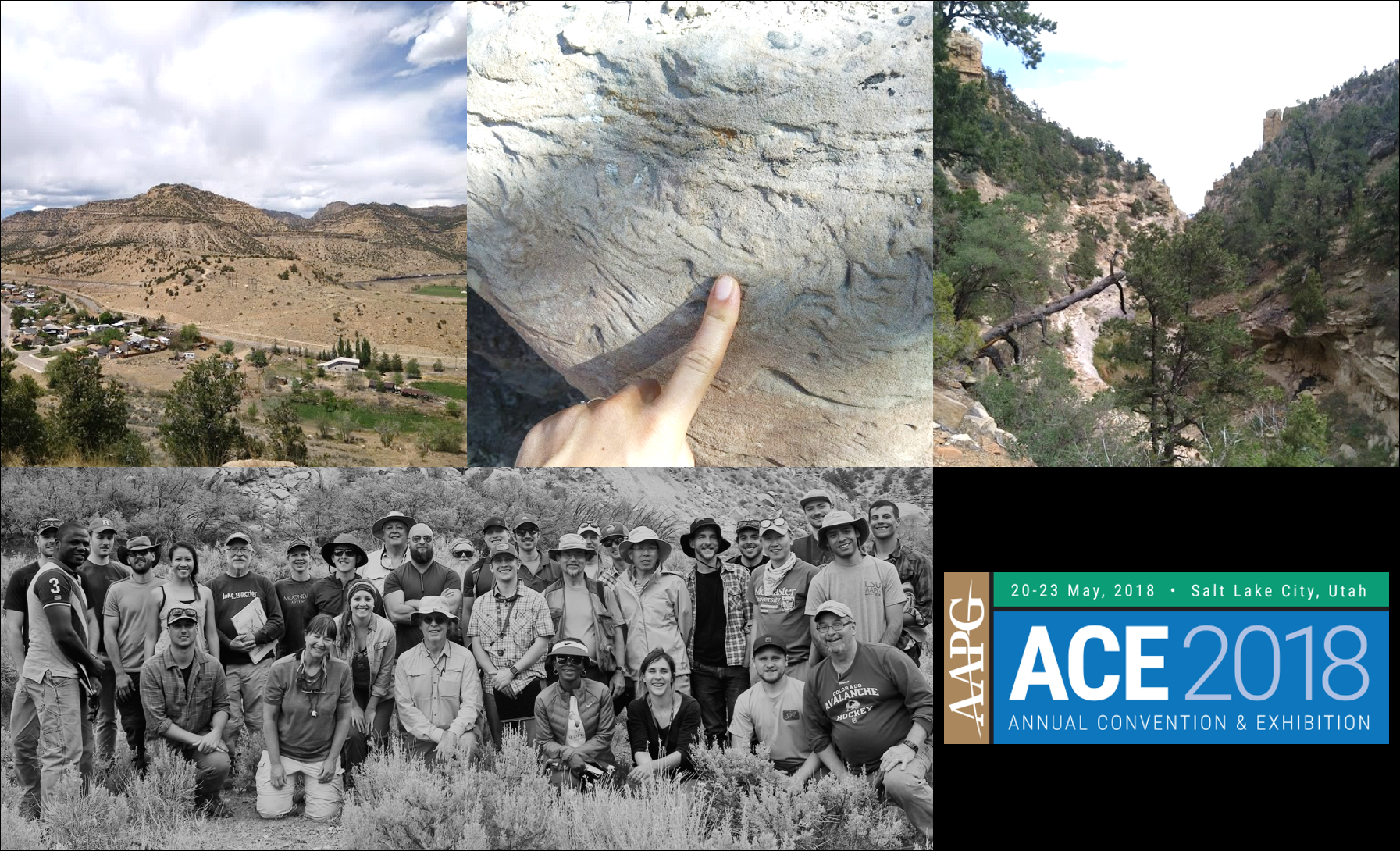
Here’s a description of the trip from the AAPG website:
“This field trip will examine classic outcrops in the northern Book Cliffs of Utah, where many concepts in sequence stratigraphy were formulated. Wave-dominated shoreface successions in the Spring Canyon Member of the Blackhawk Formation will be traced from updip, lagoonal facies through barrier island and offshore settings. Facies will be examined in a sequence stratigraphic framework, with emphasis on parasequence development. Localities visited are those where the parasequence concept was first developed. Shoreface environments will be compared to river-dominated deltaic successions in sandstones of the Panther Tongue (Star Point Member, Mancos Shale). The Panther Tongue was one of the first outcrops to which the concept of forced regression was applied. Outcrops will be used to illustrate key principles of sequence stratigraphy, and to compare the development of and differences between shoreface and deltaic systems. Many of the major oil companies visit this area to teach field schools focusing on facies and sequence stratigraphic concepts.”
– – – – – – – – – – – – – – – – – – – – – – – – – –
Field Trip 06 – Great Salt Lake: Microbialites, Past and Present
Ken attended the UGA pre-convention field trip FT06 – Great Salt Lake: Microbialites, Past and Present. Instructors on this trip were Peter Homewood, Michael Vanden Berg, Jami Butler, Jean-Charles Schaegis, Monique Mattraux, Bonnie Baxter, Carie Frantz, and Genevieve Atwood.
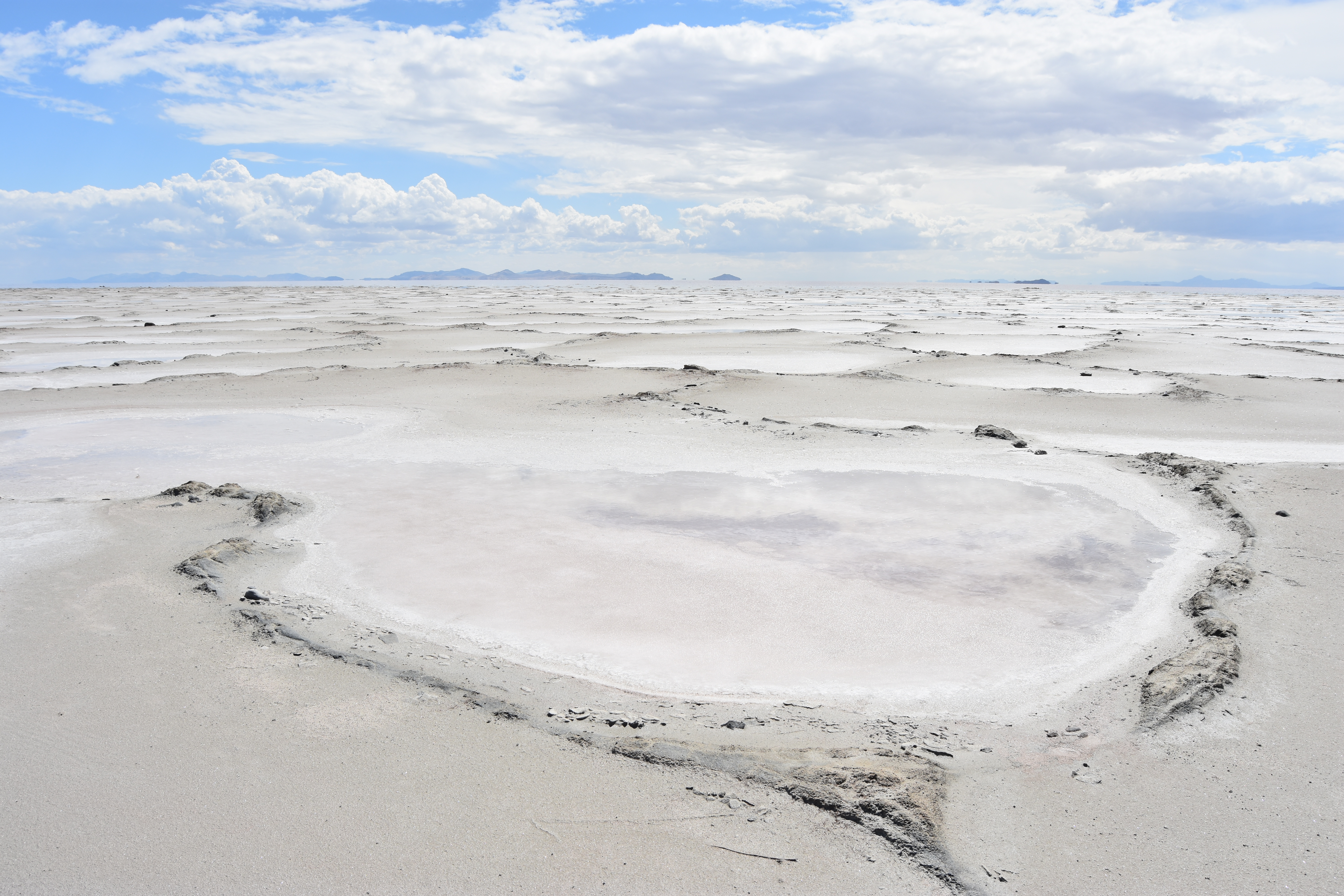
Photo ~ A view looking south across desiccation polygons along the North Arm of the Great Salt Lake, near Rozel Point (the polygon in the foreground is approximately 4m wide).
Here’s a description of the trip from the AAPG website:
“Great Salt Lake, Utah is well established as one of the main modern and recent analogues for large, salty, terminal basin lacustrine systems, particularly in the subsurface. This field trip will focus on how lake deposits have followed major Pleistocene-Holocene changes in lake level, accompanied by the chemical evolution of lake water. Modern and fossil microbialite bioherms, reefs and carbonate deposits will be examined in the context of cool groundwater or hot spring influx to the lake, as well as in the light of modern microbial systems from the saline to hypersaline lake environments. Participants will visit Antelope Island, learn about microbial life in the evaporitic environment at Spiral Jetty, and examine hot spring travertine linked to lacustrine microbialites at Lakeside. Lake Bonneville and Great Salt Lake will be placed in the context of regional Basin & Range dynamics under evolving climate patterns.”